
As late as age 50 I believed my life was on an upward trajectory. On my 50th birthday I held the belief that I’d get my business off the ground and be working for myself soon. I believed I’d get into a regular exercise routine again, figure out how to lose my extra 70 pounds, and settle into a good relationship. I fully believed I’d achieve all this in just a few years.
Now that I’ve turned 60 with none of it accomplished, these expectations feel alternately painful and comical. With increasing joint problems, decreasing sleep, and now carrying 90 pounds extra, I wonder what the upside is to growing old.
Life After 50
There are many articles and books written about how good life can be after 50. In fact, here’s one now. This article offers many reasons to appreciate getting old such as improved decision-making and better emotional intelligence. Apparently old age frees us from obligations and gives us a deeper appreciation for life. The article doesn’t say that appreciation happens because we’re more likely to kick it any day now, but I’m pretty sure that’s part of it.
I’d like to rip these points apart, which would be easy to do as a woman without financial resources or a partner, and who didn’t have children so her free time has always been her own. But that would be too easy.
I won’t be another old person ranting about how much aging sucks, but neither will I pitch the alleged benefits of growing old. Instead, let’s compare youth with elderhood and see if they’re really so different.
The Jail of Youth
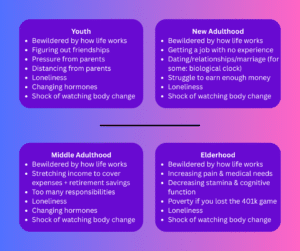
Ah, to be young again, right? Endless energy, bones that mend fast, all the decisions ahead of you and plenty of time to recover from mistakes. But being a child and then adolescent is a time dominated by PARENTS.
Remember how much your parents pressured you to do what they wanted? Whether or not they paid much attention to you from day to day, they still had expectations. And you had to at least look like you were falling in line because it wasn’t like you could just walk out.
At best, parents benevolently and with the best of intentions make you feel as if your life isn’t really yours. At worst, parents are abusive and you have no escape.
Growing up is also a time of hormones going out of control, the pain of trying to fit in with your peers, loneliness, and trying to establish some degree of independence from said parents. Not to mention the shock of changes in a body you hadn’t had to think about at all before.
The Insecurity of New Adulthood
Yeah, this is the time we all want to recover, right? All that collagen-rich skin, natural muscle tone, and even if you weren’t very attractive, you still had the glow of youth.
But being in your 20s and early 30s also means starting a career with no experience, laboring at the bottom of the ladder, and doing that “paying your dues” thing. You struggle to earn enough to live on and keep up with what your friends are doing/buying.
Speaking of friends, what counts as a friend is different now and feels much harder, so you still experience loneliness. Women who want to be mothers fear the alarm of the biological clock. Everyone who wants a lifelong partner feels the pressure of musical chair dating.
If you get married, good luck.
The Schlep of Middle Age (I’m using 40 years old as the starting point. Don’t argue with me.)
Forty years old is where middle age used to start when people had better awareness of how long the average human lives. Middle age means you’re probably no longer working an entry-level job, but you might very well be. During these years, it takes no small amount of time and effort to grow your experience, title and salary. Your career often drains you.
Or you’re trying to find a new job after getting laid off, which can happen repeatedly. In fact, lack of employment bites harder now because you’re either keeping a household afloat or socking it away for retirement, or both.
This is the sandwich part of life for family-first people. You might be raising kids and managing an aging parent at the same time. You might go through a divorce.
You’re way too busy, yet still struggle with loneliness. If you don’t have kids, you go straight to figuring out your life purpose. Maybe you find it, but probably you don’t.
And there’s plenty to disturb you as you watch your body change.
The Resignation of Elderhood (60 years old and up. Don’t argue with me.)
I don’t need to enumerate the ways old age is hard, from physical pain to disappointment over never figuring out how life works.
But considering that all stages of life have their pain and bewilderment, I think what’s really worst about being old is having memories of what all the other parts of life were like. We old ones think we know what life is like because we’ve lived so much of it, but we don’t remember it accurately. We nostalgically long for the best parts of our lives, without remembering the struggle that was part of every day, at every age.
In elderhood we experience the final shock of watching our bodies change and it feels like creeping death. But there isn’t a person on earth towards whom death isn’t creeping. That’s just easier to ignore when you think of yourself as too young to die.
All Ages Are Equally Sucky Enjoyable
I leave others to write articles about the benefits of becoming old. Those titles might include words like “silver,” “golden,” and “third act.” I, on the other hand, will stop looking for the silver lining on the cloud of old age. I take comfort in knowing that no stage of life is ideal and certainly none of it is as good as I remember.
You can also read, like and comment on this post on Substack.
0 Comments