

On Substack I see posts by people asking for writing advice. They ask how you know what to write about and how to get started. It’s clear that they’re anxious about producing writing people will like, which is an easy thing to worry about on Substack. The nature of Substack is to post writing (or video or audio) that people will click to like or make a comment about. In this way, it’s disappointingly similar to every other social media platform.
My Advice
To new writers and people who want to be writers:
- Get off Substack (at least stop posting on it. Reading it might be all right).
- Just write, damn it.
- Don’t show it to ANYONE.
I’m already sad because I know no one will do this. We’re all hooked on the social media dynamic of preening ourselves with every tiny acknowledgement of our worth. But just in case it might make some difference to anyone, here’s my story. I was born in the 1900s, so it’s impossible to recreate this, but it’s worth trying.
How I Became a Writer
I began writing as a small brown child at the age of 11. I don’t remember exactly how it started, but that’s when my journals began. I probably asked my parents for a lined, spiral notebook and I was off.
I wrote about school and things that happened to me. None of it was interesting in any way, but it felt important. It was like having a friend who would never get bored with me. I even used a typewriter for a while. I don’t remember how that started either, but I liked rolling in the paper and feeling like a grown up as I pounded out how I felt about the sixth grade.
Of course I never showed any of this to anyone. This journaling was my private accomplishment and I relished it. I kept it up through high school and college, although I didn’t write nearly as often when I was working on a bachelor’s, and then master’s, degree.
Speaking of those degrees, I majored in English which meant I did a ton of writing for evaluation, but I didn’t let that discourage me. The English PhD program at Cornell completely killed my love of literature for 16 years, but my commitment to writing never weakened.

Protect your writing. In the early days, don’t let anyone see it. Oliver Perez | Dreamstime
The journaling continued through my 20s and into my 30s, none of it seen by anyone else. Writers published stuff. My journaling was simply a crutch to get through life.
A Chance to Publish
That changed after I became active on the internet. In 2004 I learned that a friend had this thing called a “blog,” which was a collapsing of the words “web log.” On it, she wrote about whatever was on her mind. Then she published it for the world to see.
A place to write about whatever I wanted and actually make contact with others? I was in!
The button that puts your writing on the internet says Publish, so starting this blog made me a published writer. I don’t know why anyone would ever want to do this, but you can go back to my first post and try to figure out my motivation and why the heck I gave my blog this name. You can also see evidence of how early bloggers used no graphics at all. Today I’d never post without at least one image, but back then the point was writing, not spectacle.
Somewhere along the way, I became a decent writer. I suspect that happened by the time I was out of graduate school. Then I became a pretty darn good writer, probably around my tenth year as a blogger. That improvement happened by doing it: over my lifetime, decade after decade I wrote, starting with the most mundane everyday minutiae no one else would have any interest in. And before that I kept a journal.
After I started the blog, I had very low expectations of anyone reading my writing. Indeed, after the heyday of Blogger.com and after all the bloggers destined to earn book deals were done, blog readership went way down. I might have had a few hundred subscribers in 2020 when I moved from blogger.com to a WordPress site, but I lost most of them in the move. Right now there are fewer than 100 people subscribed to Chicana on the Edge.
The Final Step
But you know how I finally, actually became a writer? I began calling myself a writer. Yup, that’s what it takes. To hell with people who have definitions of writer that include publishing books, being famous, or earning money by writing. Just own it. In fact, I not only call myself a writer, I say I’ve been writing since I was 11 because that’s the truth. Sure as heck that writing wasn’t publication-ready, but it was writing. So there.
Resist the Performative Hamster Wheel (nothing against hamsters)
Social media has changed our focus from what we’re experiencing in the moment to how what we’re experiencing will look to others. This became obvious when people began holding up their phones every time anything interesting happened. I don’t know when I first stood in an audience, saw a wonderful performance start and noticed all the hands shoot up with phones pointed at the performers, but I feel chagrin every time.
Pulling out the phone means people change from experiencing the moment to documenting the moment. But you can’t fully take in an experience if you’re also framing it for some unknown audience. Maybe such people are recording the event to watch later, but will they fully experience the moment then? I suspect they’ll be distracted by how good or bad their recording is.
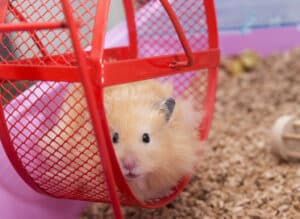
Get off the hamster wheel of performing for others. Gemenacom | Dreamstime
Please resist thinking of everything as a performance to be evaluated by the hordes. Please practice doing things just for yourself. Keep in mind, you’re not writing just for yourself if you think that if it’s good enough you’ll eventually show it to someone else. That will freeze you. Seriously promise yourself you’re writing things no one will ever see.
In The Artist’s Way, Julia Cameron asks readers to write Morning Pages. That’s the practice of pulling a notebook and pen towards you before you get out of bed, before you’re even fully awake, and writing three pages without stopping. Imagine writing three pages without stopping to think, with no hesitation at all! And it must be with pen (or pencil) and actual, physical paper.
You can write anything. In fact, I’ve written things like “I’m writing morning pages. These are my morning pages. These are my morning pages. God I want to sleep more” until an actual thought occurred to me. You have to write without stopping, and because you do this the moment you become conscious in the morning, you have permission to write any tiny thing that comes across your mind, knowing you really will dump these pages later.
It’s possible you might cough something up that’s worth turning into a piece later, but that is not the point. In fact, I’ve forgotten what the point is, but I think it’s about priming the pump, allowing yourself to let things out so it’s easier to do when you DO sit down to produce an actual piece.
So let your Substack and other accounts go dormant and just write shit down. Don’t study how to write. Don’t try to make it good. And promise yourself that no one will ever see it. You become a writer by writing.

0 Comments