
Recently, I was a moderator in a volunteer organization that had three support groups. Apparently my group had the best behaved participants. The other two groups each had one person who clearly didn’t know how to be in a group.
Ann had a lot of emotions she wanted to get out, but she had no interest in a dialogue about them. She just liked talking and having the group listen to her. Moderator Chloe knew Ann was taking too much time, but didn’t know how to tell her. So she’d wait for Ann to finish, but sometimes that meant the meeting went for two hours.
In the other group, Jill didn’t like the way Moderator Susan was treating her. Jill was certain that Susan was being unfair to her during meetings. Each week Jill’s anger got worse, but Susan had no idea what to do. Eventually, Susan found out that Jill had emailed the person she understood was Jill’s boss (he was really just another volunteer). In our moderators meeting, Susan said she was panicking over interactions with Jill.
When I listened to what these two had gone through, I was floored. Why did they sound afraid of those women? The moderator’s job is to keep things moving along and if someone is taking up too much time/attention, their job is to set a boundary.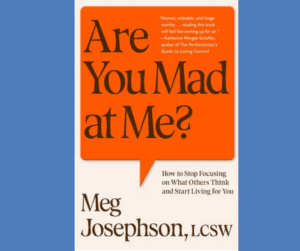
I thought it was because they were new to moderating. I’ve been doing it for decades, so I tried to give advice, but it did no good. Susan and Chloe continued to struggle until I was ready to tear my hair out. Why did they freeze up when someone was walking all over them?
A friend helped me see that Ann and Susan were exhibiting people pleasing behaviors. Of course I’d heard that term over the years and I knew it referred to people who had a hard time saying no, but I didn’t understand why people behaved that way or what made them like that.
My friend recommended the book Are You Mad at Me? by Meg Josephson. It’s written for people pleasers and gives a lot of insight into what creates them. I read the opening chapters and finally began to understand.
Josephson uses the term fawning to refer to appeasing and accommodating others, and making them the center of the people pleaser’s attention. A hotel manager might do this with an extremely important guest they must never offend. People pleasers do it with everyone.
As I read further, the following is what started sinking in.
People Pleasing Isn’t a Choice
People pleasers become hardwired for fawning when it’s necessary for survival in their childhood home. Fawning shields them from the abuse or even the violence of their caregivers. As long as they keep that person calm, things are okay, so they bend over backwards for them. Fawning becomes their go-to strategy in life. It’s their fail-safe behavior.
Eventually it’s part of their personality. They become the person who doesn’t have a preference about where to eat or how to decorate the apartment or how many hours of overtime they work. Whatever someone else wants is fine with them.
Not Fawning Feels Too Dangerous
Many people pleasers understand that fawning isn’t serving them anymore. Their friends don’t need constant agreement and might even become confused or annoyed by it. But when faced with a situation that feels similar to that childhood dynamic, it’s extremely hard for a people pleaser to override their hard wiring. When someone’s behavior triggers their childhood fear, an alarm bell goes off inside that means it’s time to fawn or risk rejection (or worse).
They Ignore Their Own Needs
In addition to fawning, people pleasers learn to ignore their own needs whenever they conflict with someone else’s. They don’t give opinions or preferences and often keep their thoughts to themselves. They definitely don’t say what they really want.
They Ignore Their Own Emotions
They also express no emotions that might upset the other person.
Sometimes They Forget Who They Are
Josephson makes the point that a people pleaser can do such a good job of not expressing her desires or feelings that she doesn’t even know what they are. As a result she doesn’t feel a strong sense of self. How does she really want to spend her time? What kind of people does she really want to be friends with? When you’ve centered your whole life around others, these questions can be hard to answer.

Panco971, Dreamstime
My Takeaways
A lot of this information was new to me and it really helped me understand Chloe and Susan. When someone started acting rude, Chloe and Susan were back in an old dynamic in which speaking up would have gotten them hurt. So they fawned by letting Ann and Jill take over. When fawning didn’t work, they had no other tools.
What looked to me like passively doing nothing was actually a very active, tried-and-true response that just didn’t work anymore. Ohhh!
What was not new to me was the childhood behavior Josephson described. I recognized it because I had done it with my mother. She was loving, funny and warm. And she was vindictive, abusive and cruel. I had fawned my way through my childhood, listening to her, never talking back, and doing for her even when I was exhausted. I knew her behavior was unfair, but I never spoke up to her.
I was in my 20s and had moved far away before I had the nerve to express what I wanted. I started setting boundaries and telling her what I needed. She gave me the space I needed only because I gave her no choice. It didn’t stop her abusive behavior, which continued another 20 years until I finally stepped out of her life entirely, but my early boundaries stopped her from draining me on a daily basis.
What Helps?
I finished Josephson’s book feeling puzzled. I actually had a lot in common with people pleasers, so why wasn’t I one of them?
Are You Mad at Me? is for and about people pleasers, so it can’t answer that question and neither could my therapist, so I asked Claude.ai. Sure, why not? All I wanted was a ballpark idea.
Claude gave a couple of possibilities, but the one that struck me as the most likely is about sense of self. While my sense of self relies to some extent on the opinions of others, it doesn’t rely as much as the sense of self of others. In other words: I do less worrying about what others think of me than most people do. This is both good and bad as you might imagine. My social responses aren’t always predictable and I take social risks others avoid (I don’t know why I’m like this).
This might explain why, even through all my fawning when I was growing up, I was aware of my anger and disgust with my mother. I never wanted to be like her. I didn’t even want to look like her (I do). These feelings were strong and I was very aware of them from elementary school through college. I never fully sublimated who I was, so my sense of self emerged quickly once I was away from her.
Reducing the Judgment
Since reading Are You Mad at Me? I see people pleasers differently. I wish everyone were comfortable asking for what they want, but they’re not. For some, it’s a matter of learning how to manage difficult people, but for others it requires deep work on their inner mechanisms. Susan and Chloe can’t simply set boundaries and stick to them. It would take much more to re-learn their reactions when things feel out of control.
I wanted this post to be another how-to on how to ask for what you want (like Part One on restaurant service), but it’s turned into an examination of why some people cannot ask for what they want. Maybe this post was to remind me when I lose patience with someone for not asking for what she wants, remember that she’s doing her best and that her childhood was probably scarier than mine.
You can also read or comment on this article on Substack.


0 Comments