
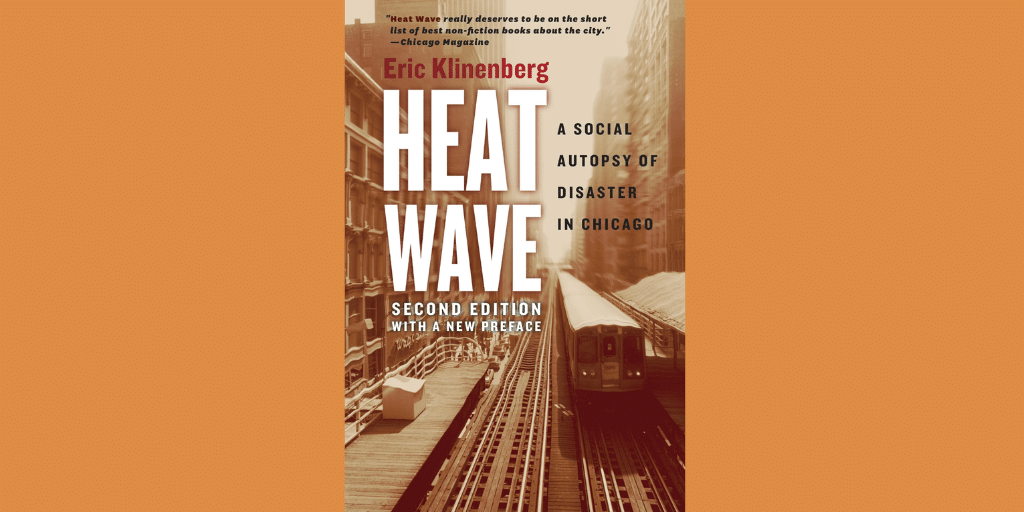
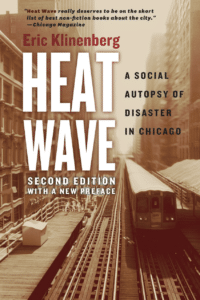
Statistics and sociological analysis from Eric Klinenberg’s Heat Wave: A Social Autopsy of Disaster in Chicago. I strongly recommend it.
In 1995, from Wednesday July 12 through Friday July 14, temperatures in the city of Chicago climbed to over 100º Fahrenheit (38º Celsius). On Thursday July 13, the high temperature was 106º F (41º C). The heat index (how hot it feels) reached 126º F (52º C). Opening our windows did nothing to cool down apartments.
Temperatures stayed in that range for three days in a row. People without air conditioning sprayed water from fire hydrants they opened. Those with transportation looked for public spaces with AC. People became sick from the heat and called ambulances that quickly became overwhelmed. And hundreds of people died in their homes, unable to cool down, without transportation to go somewhere cool, and with no one to check on them and help.
The final count of heat-related deaths was 739 people. In three days.
I lived in a second floor apartment of a walkup building (no elevator). It was my second year in Chicago. In California and upstate New York, I had learned that no matter how hot it got, temperatures cooled in the evening. I was completely unprepared for that Chicago heat wave.
Temperatures didn’t drop below 80º F (26º C), even at night. It was only because I had shul on Friday evening that I avoided a serious health problem. Members of the congregation saw my symptoms of heat exhaustion and had me lie down and hydrate. A member of the synagogue let me stay in her air conditioned condominium that night. After that I learned the symptoms of heat exhaustion and watched out for them.
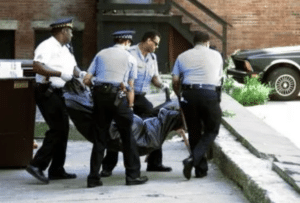
Photo by Phil Greer, Chicago Tribune
The First Responders
When people started calling 911 with heat-related emergencies, ambulances struggled to keep up with demand. Overwhelmed, they couldn’t respond fast enough, leading to big delays.
The city began sending fire fighters to pick people up, but when the hospitals reached capacity they stopped accepting patients. Ambulances drove from hospital to hospital to find one that wasn’t completely full.
From Eric Klinenberg’s Heat Wave:
According to an Illinois state senate report, “With 23 hospitals on bypass status at various intervals during the period July 13-16, 1995, very few, if any hospitals on the South and Southeast sides of Chicago were available to accept patients delivered by emergency ambulance.”
Chicago had preventive care programs and disaster management, but the administration didn’t understand that the coming heat wave would need any of that. When hospitals and emergency responses became overloaded, the city government was slow to call in help and mostly didn’t.
When people started dying in their homes, there were no ambulances to pick up bodies. Police officers were called upon to do that work, bringing corpses to the Cook County Medical Examiner’s Office. When that office’s 222-bay holding capacity ran out, the owner of a meat-packing company offered nine huge refrigerated trucks to hold bodies. Filled, those trucks occupied the parking lot of the ME’s office for days.
Even after temperatures cooled a little, the death count rose.
The City’s Response
The city government didn’t see how serious the heat wave was going to be, and then was slow to recognize the catastrophe it was turning into. Once it understood, its focus was mostly on how bad they were going to look.
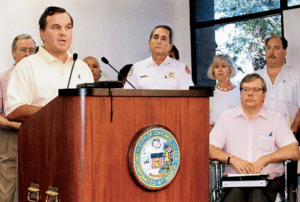
Mayor Daley two weeks after the disaster. Photo: Brian Bahr/AFP/Getty Images
The mayor in 1995 was Richard M. Daley. His administration had been working hard to improve Chicago’s image so it could attract more businesses and increase tourism. Daley very much wanted to present a smoothly running city that listened to its people. Public image was critical to him.
First, the Daley administration denied that the heat was really causing that many problems. When that story crumbled, they denied how high the numbers were of people that were dying. When they couldn’t keep that up, they insisted that those deaths weren’t all heat-related.
Daley was furious with Chief Medical Examiner Edmund Donoghue for talking about how many had died from the heat, but when experts from around the country and the Centers for Disease Control confirmed the number of heat deaths, Daley had to stop fighting the facts. Instead, he changed strategy again, saying there was nothing the city could have done to prevent those deaths because it couldn’t control the weather.
The Press Coverage
The press could have gotten out the word on how to identify heat-related illness, who to call for transportation help and other practical yet life-saving information. They didn’t.
After the temperatures cooled, they could have covered the story of what had gone on behind government office doors, and out in the city, especially in the areas populated by large numbers of Black residents, elderly residents and those living in poverty. But they were limited by their own focus: hooking readers and selling papers.
They were also hampered by their own processes, such as writers in the field not being the ones who finished the final copy before it was published. Also, those closest to the facts weren’t part of deciding whether to run a story on the front page or in the middle of the paper.
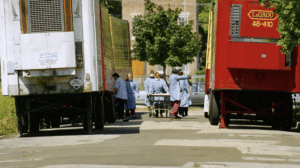
Cook County morgue technicians work between a row of refrigerated trucks. AP Photo: Mike Fisher
Some reporters worked for months on an in-depth story that uncovered just where the city had failed, but it was never published because by the late fall editors didn’t think people wanted a story about the summer.
What Really Went Wrong
Klinenberg spent years talking to first responders, families of the deceased, and people who had worked in the government and the media that summer. He found that the real problem wasn’t the heat. It was the neglect.
The areas with the highest rates of heat-related deaths were predominantly Black neighborhoods. Elderly residents were vastly overrepresented in the numbers, with the most deaths among senior residents living alone. Klinenberg found that many more solo elderly men died than solo elderly women, mainly because women usually have more skills in staying socially connected.
Klinenberg’s research suggests that far fewer would have died if the city had had certain programs and services in place, especially for older people who lived alone. These are some of the things the city should have had in place long before that summer:
- A network that keeps isolated seniors in touch with others who can make sure they have what they need.
- Strong senior community centers serving as pipelines for health information and other critical information.
- Social programs and dedicated staff to manage aging populations instead of expecting fire and police departments to do it. Employees in those departments resist doing “soft service work.”
- Chicago Housing Authority senior housing that’s safe from dangers to the elderly and with air conditioning in the common areas.
- City government more focused on serving the population than on maintaining a model city image.
- Less distance between the most marginalized communities and City Hall. As it stands, more affluent constituents who know how to “work the system” get what they want, while those with few resources and less savvy on how things work face funding cuts or simple neglect by the city.
- Revitalization programs for neighborhoods like North Lawndale that used to be active with grocery stores, commercial businesses and places people congregated to socialize. Changing economic conditions have left these neighborhoods with vacant properties, few places to buy food, and empty lots that provide cover for illegal activity. These neighborhoods need renewed infrastructure and revitalized commercial areas.
An active neighborhood brings out people who live alone, connecting them to families, churches and neighbors. Those ties are critical in a crisis.
 Lower income people are more politically vulnerable. The elderly are more physically vulnerable. Klinenberg’s research shows that instead of listening to these populations and providing what they need, Chicago focuses on those with the most money and the loudest voices. The city government runs as a business more than as a civil body that serves its people. (It has, however, greatly improved its heat-related disaster response.)
I’ve given only the briefest outline of what Klinenberg’s book covers, so please read it. It shows the true tragedy of the 1995 heat wave: the city’s deadly infrastructure and political dynamics. Sadly, the city of Chicago still hasn’t given its most vulnerable residents the attention and services they badly need. Infuriatingly, it never will. Worse, it reflects the political and racial dynamics of most American cities.
You can also read or comment on this article on Substack.


0 Comments