
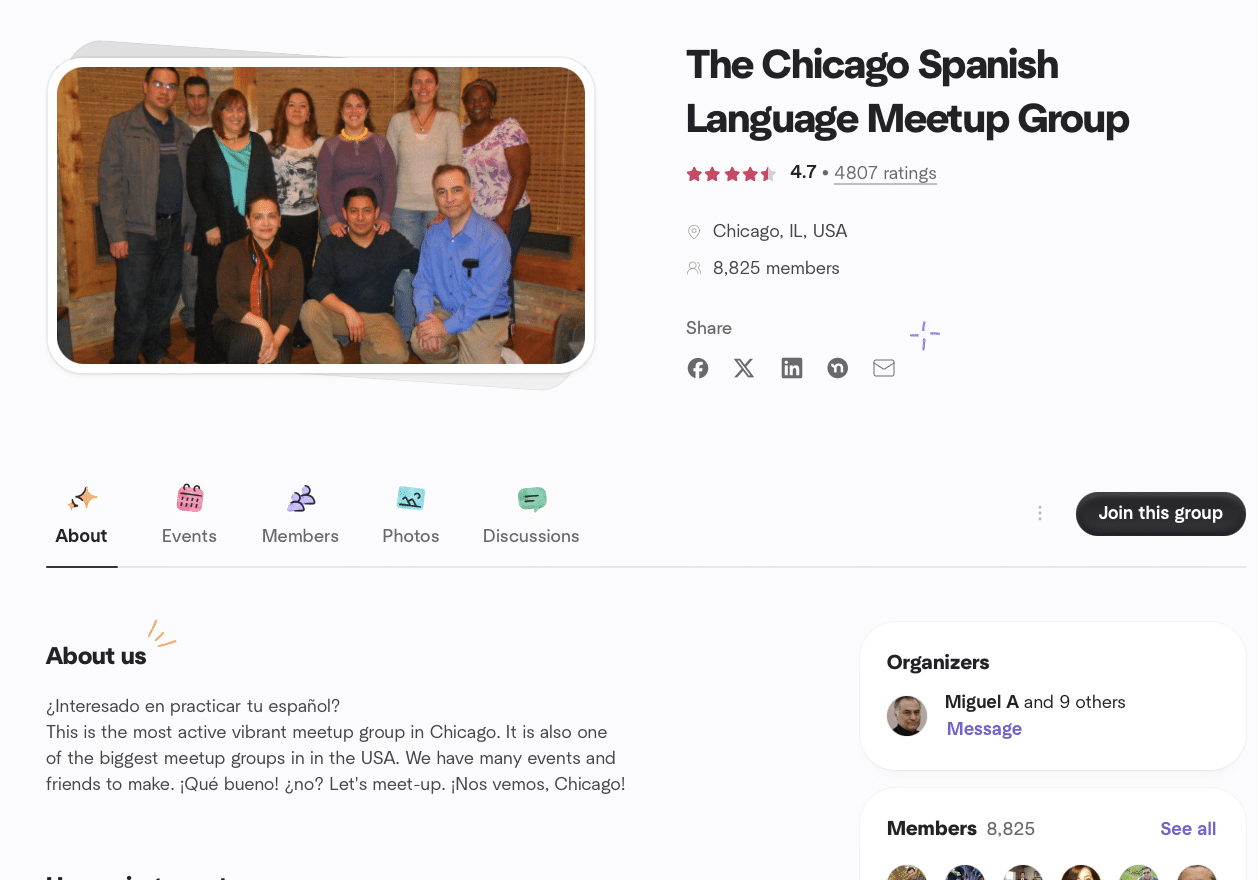
Last night I went to a dinner of The Chicago Spanish Language Meetup Group. I joined it about a year and a half ago, but practicing Spanish is one of the biggest chores of my life and when I have a chance to practice, I always put it off.
It didn’t start out well.
The place we met was an inexpensive, friendly taquería in Rogers Park, and I approached a very long table with a few people at it. They greeted me and I sat down. So far, so good. The organizer of the group introduced himself. He was clearly a native Spanish speaker, so I steeled myself to try to understand whatever he said. He said he was Mexican, but “un mexicano de México, no de California.”
I looked at him, stunned. “Por qué hablas de California?” * (translation at end of this post.)
He smiled and reassured me, “Porque hay muchos mexicanos de California pero soy de México.” He looked at my blank face and said, “Es una broma que soy de México y no de California.
I said, “Es mal ser de California?”
”No, no. Es una broma.”
I said, “Soy de California.”
He smiled, “Ah, eres de California! Bueno.”
It was the awkward moment when someone makes fun of a place and then finds out someone in the group is from that place. I had already felt guarded, but now I sat back from the table, looked away and withdrew from talking to him.
 I ate the (really not very good) enchiladas I’d ordered and tried to join a conversation to my right, but they were a few seats away and I couldn’t hear them.
I tried to relax. The white man across from me was eating flautas. His accent was very good. I didn’t understand why my chicken enchiladas had come with a steak knife, so I said, “Por qué me dió una cuchara?”
He looked puzzled, so I held up the knife. He said, “Un cuchillo.”
“Sí, un cuchillo.” **
He chuckled and I said, “No, no ries, por favor.” Now I realize it was probably the polite chuckle Midwesterners often make when there’s some awkwardness or discomfort, but I have no sense of humor at all about my Spanish-speaking (in)ability.
Now I felt like I’d been insulted and laughed at. I only ate half my dinner and sat miserably. Almost 60 years old, I’m certainly old enough to look fluent in Spanish, but there are several expectations you’d have of an elder Latina-looking woman that I don’t meet. It occurred to me that I could leave, but I decided to stay and take my punishment.
(All conversation I describe in this post was said in Spanish, so please imagine that.)
 After a while, I spoke a few words to the white man to my right, but the conversation petered out after we’d said where we each lived and I’d asked him why he had come to this event. He said he wanted to learn Spanish because he taught Spanish speakers and because he liked to travel. He didn’t ask me why I had come, so I didn’t have to tell him that I feel never-ending social and cultural pressure to become a fluent Spanish speaker.
I sat and gazed towards the conversation on my right that I couldn’t hear and the conversation on my left that seemed too fast for me. This evening was going badly.
Eventually, I decided to try to understand the conversation to my left. A young white man with a very strong American accent sat next to me, and he was discussing Mexican history with the host. My accent was much better than his, but he clearly had intellectual vocabulary, no problem understanding Spanish, and could talk on an academic level about history, philosophy and politics. I’ve never had that level of facility in Spanish and I never will. My sense of failure overwhelmed me as it does every time I’m in a Spanish-speaking environment.
Some time after that, I noticed I’d been there for an hour. I told myself I could reasonably leave now, I’d put in my time, but no one else was moving and I still believed I deserved this humiliation. I stayed.
 I don’t know what motivated him, but the Mexican-from-Mexico host eventually turned to me and the two white men I’d talked to so far. We began a discussion about where we all lived and for how long. This I could do, especially since I felt mostly (but not totally) okay stopping the host and asking what words meant.
This problem went both ways. All evening, I stopped talking in the middle of every fourth sentence because I didn’t know the Spanish word for pressure or graduate school, etc. endless etc. I could not talk anywhere near the level I wanted to. This is the pain shared by every adult who learns a language and tries to have a real conversation in it: we have an adult intellect, but can only speak at a 5-year-old level. It’s a horrible handicap and many Americans have no idea what this struggle feels like.
Annoyingly, when I asked what a word meant, the white man across from me would translate into English. He did this a couple of times, so I said, “No, no en inglés. Quiero la definición en español.” It felt insulting, like I was a stupid American abroad. I was not a Mexican American who needed some gringo to translate for me.
 Eventually the conversation really got rolling (and the white man across from me stopped translating) as we talked about tv shows, books and movies. This level of conversation in Spanish I could manage. They gave their favorite shows and I said I liked horror movies and books. I managed to explain about my prosopagnosia so they’d know I wouldn’t recognize them when I saw them again (I had to say prosopagnosia in English).
A young man had joined us who tried to make a joke about my prosopagnosia (he said if I couldn’t remember faces then maybe the palm of his hand would help, and he held it in front of my face). I unsmilingly said it’s not good to make fun of a disability (I consider prosopagnosia a social disability). They all agreed and he seemed to feel bad about his comment.
I left when I’d been there two hours and on my way home I looked up the Spanish translations of to envy, to disappoint, graduate school, and “For me production precedes comprehension.” I’ll have to also look up: “And my production sucks.”
* The host introduced himself by making the “joke” that he’s a Mexican from Mexico, not from California. I told him I’m from California.
** I called a knife a spoon. When the man corrected me, he laughed and I asked him not to.
Other posts on this topic:
Or in the Topics list to the right, click on Spanish.
Or use the Search bar to search for Spanish.


Hi Regina,
I hear you.
“we have an adult intellect, but can only speak at a 5-year-old level. It’s a horrible handicap and many Americans have no idea what this struggle feels like.”
This american sympathizes 100%. I spent 4 years learning Spanish with DuoLingo – I know, I know – before graduating myself to another more sophisticated app with real practice and real people. I felt pretty good (already learned French, rudimentary modern Greek) until we went to Buenos Aires. It was like I forgot everything. Yet … I persisted and refused to speak English even though many many locals did speak it well. However, I did learn *permanently* (I think) to ask for una mesa _por_ dos rather than para dos after the waiter corrected me (graciously).
You either give up or eventually get there, I feel.
Thank you for your comment, David. I feel you either give up or eventually get there or never give up and never get there.