
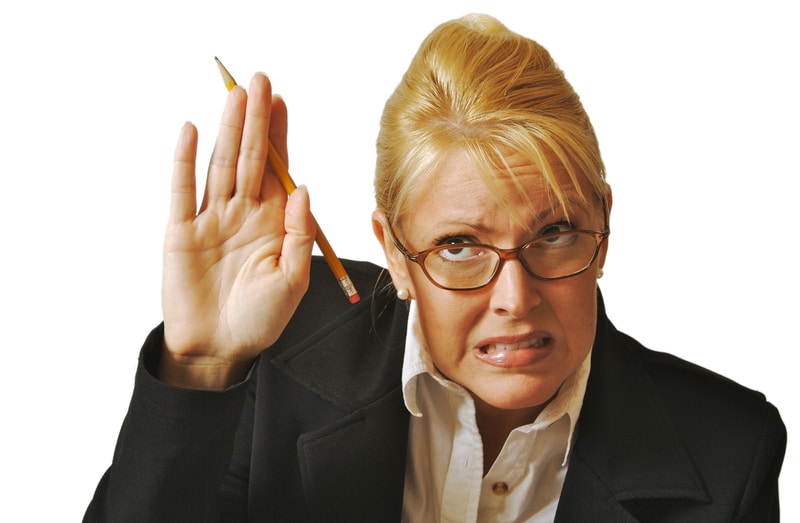
On National Apology Day, I admit that the meaning of “I’m sorry” has become confusing for me. Growing up in the 70s and 80s, I learned that you say “I’m sorry” in two situations:
- When you make a mistake, in order to take accountability for what you did/said/were part of.
- When it’s not your fault, but to express sympathy or regret, as in “I’m sorry for your loss,” “I’m sorry I startled you,” or “I’m sorry you had a bad day.” It’s polite.
But I’ve noticed that people often don’t apologize in situation #1 anymore. More surprising, now they’ll often say “sorry” in these kinds of situations:
- They’re in a meeting and they raise their hand to ask a question. When they’re recognized they say something like, “Sorry, I just wanted to know if the program includes a Q&A part?”
- You walk through a door and startle someone on the other side. They say, “Sorry!” even though neither of you was in any danger of running into the other.
- They’re expressing confusion or disagreement, as in “Sorry, did we say we’re meeting at 7 or 8?” or “Sorry, that’s just not how I’d spend my free time.”
- I was out with a friend and the server got her order wrong. As he walked away to take the plate back to the kitchen, she called after him, “Sorry!”
This behavior baffled me for quite a while. What were they apologizing for? What transgression did I miss? And why apologize at the very beginning of an interaction, before anything has happened?
One day I asked a Millennial friend. Michael explained it like this:
At this point, ‘sorry’ means ‘Don’t hurt me.’
OHHhhh. I thanked him profusely because that made sense. “Sorry” has become a defensive move, a request for you to go easy on them. That’s why it comes at the beginning of the interaction.
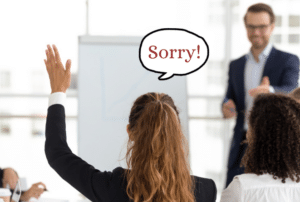 It also explains why my friend called “Sorry!” after the server who was heading back to the kitchen. I thought, “He made the mistake. Why the heck is she apologizing?”
Now I get it. Maybe she was asking him not to be mad at her for the extra work or to not think she was a bitch because she sent food back.
As we’ve been using “sorry” more and more to deflect or defend, we’re using it less and less for accountability. Many people don’t apologize for mistakes anymore. I once took food back to a fast food counter because they gave me wrong thing. I expected a apology, but the person just took the order back and gave me the right thing. When I asked if she was going to apologize for her mistake, a coworker leaned over and whispered to her, “You don’t have to answer that.” I was floored. Is this what American customer service is like now? What happened to the accountability apology?
Another time my boss once left me off an important email about a deadline. I learned this four days before the deadline, but when I told her, she didn’t apologize either. Instead, she told me that the deadline had been moved so now I had two weeks to submit. Even when I pressed her, she didn’t apologize. She just repeated that everything was good because the deadline had changed.
So then I started wondering: Why is the accountability apology disappearing?
A Gen Z-er explained that part to me. She said most apologies are insincere and don’t do anything to fix the situation. She and her peers would rather fix the situation than offer empty words. It makes perfect sense. And I hate it. Sure, most apologies aren’t sincere, yet this shift in social protocols feels wrong to me, like we’re becoming less polite.
I have to remember that every generation changes the language. It’s not just slang that changes, but what counts as polite and what we expect in a given social interaction. Things change, decade after decade, and I have to accept it. I’m an old woman and this is their world now.
My linguistic journey also gave me another reason to appreciate my younger friends. I need friends of all different generations to help me make sense of life (probably true of everyone).

Dragoscondrea dreamstime ID 302388040

0 Comments